
The William Whewell Centre for Science and Natural Theology is an independent academic centre focusing on science and theism. Scientific discoveries in the 20th and 21st centuries have generated new data supporting a theistic worldview. This compelling evidence merits a reinvestigation into the question of natural theology: Does nature itself reveal the activity of a divine Mind? The Whewell Centre aims to foster critical analysis and discussion of this and other questions that arise from research and evidence in the natural sciences, social sciences, and the history and philosophy of science. To this end, the Centre seeks to mentor students, host faculty, and engage the general public.
Events
Michaelmas Lecture Series
Lectures are free and open to all. No tickets are required.
8 October 2026
Stephen C. Meyer on “The Demise of the New Atheism and Return of the God Hypothesis”
Details
Location: Sibilla Room, Jesus College, Cambridge
7:30 PM: Drinks reception
8:00 PM: Lecture followed by Q&A
Event ends around 9:30 PM
Richard Dawkins has famously said that the universe we observe “has precisely the properties we should expect if there is, at bottom, no design, no purpose … nothing but blind, pitiless indifference.” But discoveries about the origin and complexity of the universe and life over the last century have repeatedly confounded the expectations of scientific atheists and instead confirm those of philosophical theists. In this talk, Meyer argues that theistic design now provides the best overall explanation for these unexpected discoveries, thus supporting a “Return of the God Hypothesis” and a revival of the natural theological research programme.
Stephen C. Meyer received his Ph.D. in the philosophy of science from the University of Cambridge. A former geophysicist and college professor, he now directs the William Whewell Centre for Science and Natural Theology in Cambridge. He has authored Signature in the Cell, a Times Literary Supplement Book of the Year, Darwin’s Doubt, a New York Times best seller and Return of the God Hypothesis, a U.S.A Today best seller. In addition to articles in scientific and philosophical journals, he has published opinion-editorial columns national outlets such as The Wall Street Journal, Newsweek, The Jerusalem Post, The Los Angeles Times, The National Post of Canada, U.S.A. Today and The Telegraph.
19 October 2026
Steve Fuller on “William Whewell as our Contemporary”
Details
Location: WYNG Gardens classroom, Thompson’s Lane, Trinity Hall, Cambridge
7:30 PM: Drinks reception
8:00 PM: Lecture followed by Q&A
Event ends around 9:30 PM
William Whewell, the natural theologian who coined the term ‘scientist’ nearly two centuries ago and is now regarded as a founder of the philosophy of science, is normally treated as a historical figure who appears in equal measures insightful and idiosyncratic. However, his insights remain evergreen and are relevant to scientists today, including supporters of intelligent design theory, with whom he would clearly be sympathetic. Prof Fuller will review aspects of Whewell’s thinking about the nature of science that remain crucial, not least the idea of ‘consilience’, which Whewell believed made Newton the greatest scientist in history, setting the gold standard for any successors. Nowadays this view is taken for granted by both philosophers and the public – and perhaps even by practicing scientists. But exactly what general lessons did Whewell draw from Newton’s methods and achievements that might inform the orientation of intelligent design research today?
Steve Fuller is the Auguste Comte Chair in Social Epistemology at the University of Warwick. Trained in the History and Philosophy of Science, he is the author of thirty books ranging across the science-religion relationship as well as the future of the university and humanity more generally.
2 November 2026
Paul A. Nelson on “Did Darwin Destroy Natural Theology?: The Minimal Cell Threshold and the Problem of the Origin of Life”
Details
Location: Sterne Room, Jesus College, Cambridge
7:30 PM: Drinks reception
8:00 PM: Lecture followed by Q&A
Event ends around 9:30 PM
In what may be the last letter he sent, three weeks before his death in 1882, Darwin said that the question of the origin of life was “altogether ultra vires” — i.e., beyond the strength of natural science at the time. His intellectual offspring have not been as pessimistic. In large measure this is because of the philosophical revolution, methodological naturalism, introduced by the wide acceptance of Darwinian reasoning, where the paired tools of chance and necessity are seen as necessary and sufficient to solve any puzzle. Nature herself, however, has a permanent vote on the matter. Cells have shown themselves to be, not an assemblage of atomistic parts, but a system of functional relations, with a discoverable lower threshold of complexity. This analysis bears directly on the adequacy of methodological naturalism for explanation.
Paul A. Nelson is a Senior Fellow of the Discovery Institute and Adjunct Faculty in the MA Program in Science & Religion at Biola University. He is a philosopher of biology who has been involved in the intelligent design debate internationally for over three decades. His research interests include orphan and taxonomically restricted genes, developmental biology as it relates to the history of life, and the theory of intelligent design. Paul received his PhD in the philosophy of science and evolutionary theory from the University of Chicago (1998) and is a member of the Society for Developmental Biology. His articles have appeared in journals such as PLoS One, Biology and Philosophy, Zygon, and Rhetoric and Public Affairs, and books such as Next Generation Systematics (Cambridge University Press), Intelligent Design Creationism and Its Critics (MIT Press), and Darwin, Design, and Public Education (Michigan State University Press).
3 November 2026
Richard Buggs on “The Cambridge Quest to Solve Darwin’s Abominable Mystery”
Details
Location: Plumb Auditorium, Christ’s College, Cambridge
7:30 PM: Drinks reception
8:00 PM: Lecture followed by Q&A
Event ends around 9:30 PM
In 1879 Charles Darwin confided in the Director of Kew Gardens that “the rapid development as far as we can judge of all the higher plants within recent geological times is an abominable mystery”. His admission came two years after the Keeper of Botany at the British Museum published a lecture claiming that “the facts of palaeontological botany are opposed to evolution” and that instead the plant fossil record fits with “a series of developments” by “a supernatural Creator”. It is widely accepted that Darwin’s abominable mystery persists today, after 150 years of scientific progress. This lecture will outline a history of the mystery, with an emphasis on contributions made by the Botany School at Cambridge University in the first half of the twentieth century.
Richard Buggs is Senior Research Leader (Plant Health & Adaptation) at Royal Botanic Gardens Kew, and Professor of Evolutionary Genomics at Queen Mary, University of London. He sits on the UK Government Trees and Woodlands Scientific Advisory Group, the Expert Committee on Forest Science, and the Royal Society Research Grants Committee: Biological Science. The birch tree species Betula buggsii is named after him. He read Natural Sciences at Cambridge University as an undergraduate, and was elected a Bateman scholar at Trinity Hall. His holds a DPhil from Oxford University and did postdoctoral work at University of Florida. His research on plant evolution has been published in over 80 papers, in journals including Nature and Science.
10 November 2026
Paul A. Nelson on “Design Triangulation and the Size of the Molecular Universe: How Intelligent Design Advances the Progress of Science”
Details
Location: Plumb Auditorium, Christ’s College, Cambridge
7:30 PM: Drinks reception
8:00 PM: Lecture followed by Q&A
Event ends around 9:30 PM
In 1955, in an unpublished manuscript circulated to the members of the RNA Tie Club, Francis Crick predicted the functional necessity of an “adaptor” molecule to bridge the very different chemistries of nucleic and amino acids, in DNA and proteins, respectively. The adaptor was isolated and characterized in 1958 and later given the name of transfer RNA. Crick’s remarkable prescience was grounded in a mode of reasoning which may be called design triangulation, a name fitting to the logic of the inference. Today, 71 years after Crick’s adaptor prediction, discoveries of the unexpected genetic and proteomic diversity of life on Earth invite new applications of design triangulation. If wisdom is justified by all her children, since William Harvey’s prediction of the circulation of the blood, the method of design triangulation has proven itself justified by its many empirical children — fruitful discoveries in biology.
Paul A. Nelson is a Senior Fellow of the Discovery Institute and Adjunct Faculty in the MA Program in Science & Religion at Biola University. He is a philosopher of biology who has been involved in the intelligent design debate internationally for over three decades. His research interests include orphan and taxonomically restricted genes, developmental biology as it relates to the history of life, and the theory of intelligent design. Paul received his PhD in the philosophy of science and evolutionary theory from the University of Chicago (1998) and is a member of the Society for Developmental Biology. His articles have appeared in journals such as PLoS One, Biology and Philosophy, Zygon, and Rhetoric and Public Affairs, and books such as Next Generation Systematics (Cambridge University Press), Intelligent Design Creationism and Its Critics (MIT Press), and Darwin, Design, and Public Education (Michigan State University Press).
16 November 2026
Joshua Welch on “Minds, Brains and Machines: AI, Quantum Physics, and the Soul”
Details
Location: Sterne Room, Jesus College, Cambridge
7:30 PM: Drinks reception
8:00 PM: Lecture followed by Q&A
Event ends around 9:30 PM
Christian faith is often perceived as a “science stopper”, leading people to stop seeking scientific explanations. But what if the opposite is true? Here, I show how a natural theology approach suggests new avenues of scientific research into the mind-brain problem that other worldviews may resist a priori. Christian theology speaks of real things that are not particle-like, allowing us to accept striking phenomena in quantum physics — superposition, collapse, and entanglement — that point to reality beyond particles. Christians also view the human person as more than an algorithm or neural network. From this starting point, I propose a novel quantum mechanism for a mind-brain interface that neither violates energy conservation nor requires large-scale quantum coherence. This leads to testable predictions and highlights limitations of current AI systems.
Joshua Welch is an Associate Professor of Computational Medicine and Bioinformatics and Computer Science and Engineering at the University of Michigan. He earned his PhD in Computer Science from the University of North Carolina at Chapel Hill and performed postdoctoral research in neuroscience at the Broad Institute of Harvard and MIT before joining the faculty at Michigan in 2018. His academic research focuses on developing artificial intelligence techniques for deciphering gene regulatory mechanisms of the cell, with an emphasis on brain development and neurological disease. His research has been published in leading scientific journals, including Nature, Cell, Nature Biotechnology, and Nature Genetics. He also helped to launch the Michigan Christian Study Center in 2022 and currently serves on the board of directors for the Center.
Past Events
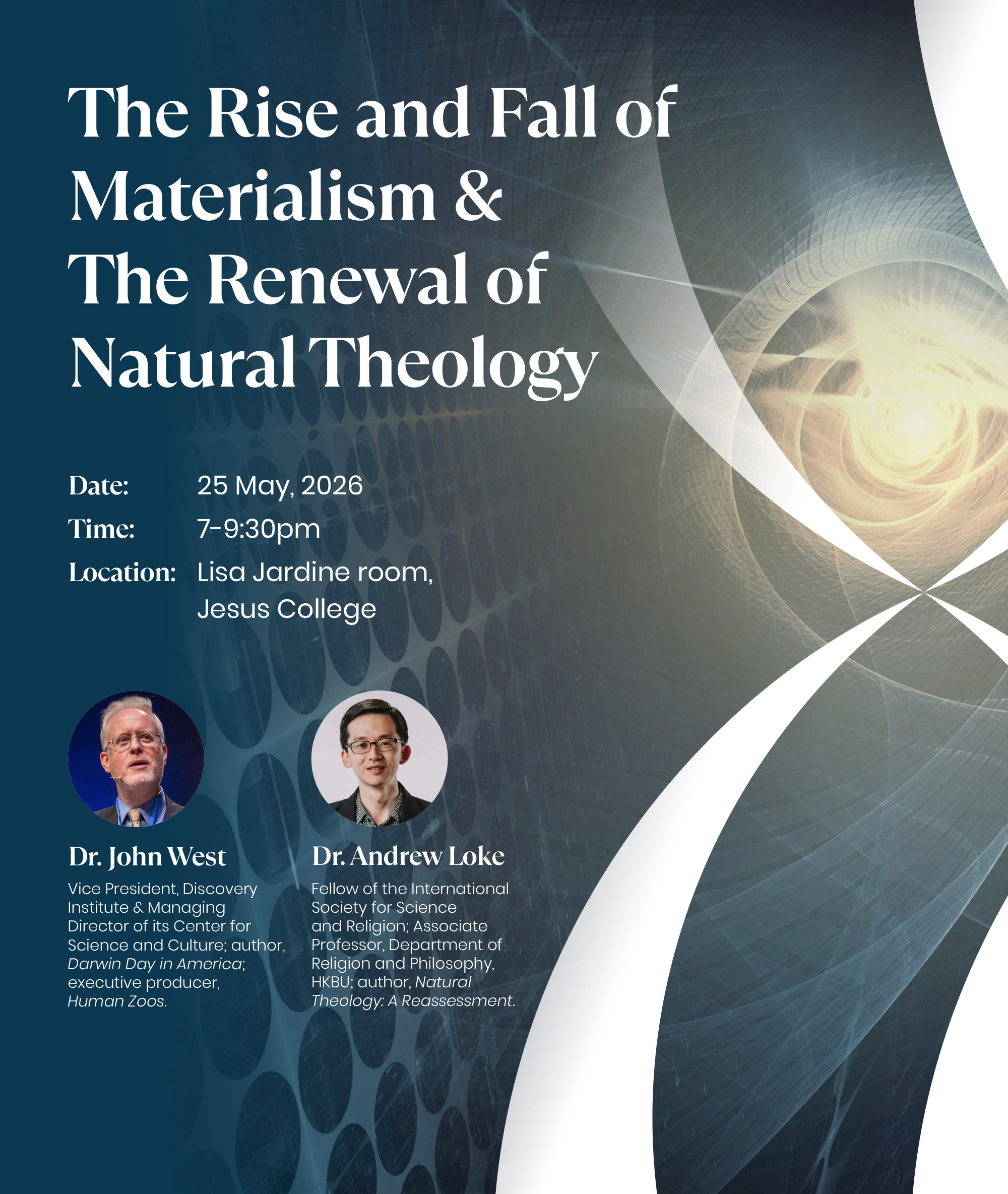
- 25 May 2026: “The Rise and Fall of Materialism & The Renewal of Natural Theology” with Dr. John West and Dr. Andrew Loke.
- 2025 Autumn Lecture Series
The Whewell Centre is an initiative of Discovery House, a Cambridge-based organization that mentors students and fosters research on the relationship between science and theistic belief. Discovery House is a program of Discovery Institute’s Center for Science and Culture. Contact the Whewell Centre at info@whewellcentre.uk.